
 By Moses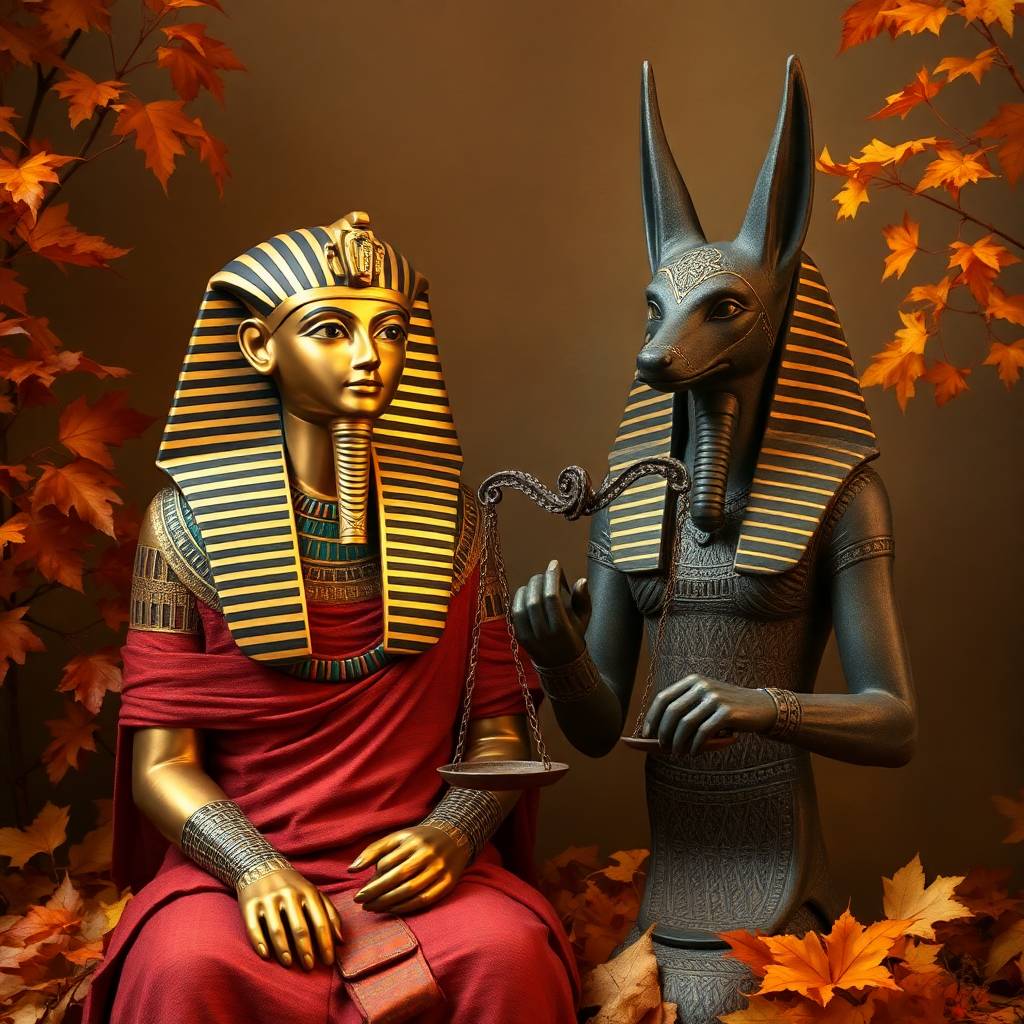
You stand at the threshold. Anpu (Anubis), jackal-headed guardian, takes your hand. He is calm, sure, and steady. This picture is not a horror story — it is a map. It tells what happens when the body ends and the spark moves on, how life is measured, and what it means to fail. Read this like a neighbor pointing out the path. Do not treat the words as mystery for priests — treat them as practical truth for your life.
1) The Passage Begins: Body, Spark, and Preparation 🕯️
When the body ceases, the spark inside does not vanish. The body is prepared: washed, wrapped, given food for the road. Why? Because ritual keeps the spark whole enough to travel. Think of the body as the boat and the spark as the traveler. The care given by the living helps the spark reach the hall intact.
Anpu meets you at the gate and holds your hand so you don’t wander. He knows the way. He is a guide, not a judge — at least not yet. Calm your breath. Follow his step.
2) The Hall of Two Truths: The Feather and the Heart ⚖️
You are brought into the Hall of Two Truths, where the heart is weighed against the feather of Ma’at — truth, balance, and right-order. On one scale sits your heart: the record of your life, heavy with choices, words, and deeds. On the other sits the feather.
- If the heart floats like the feather: you have lived in balance. You pass.
- If the heart is heavy with lies, greed, or cruelty: it drags the scale down and you fail.
This is not about loud faith or public postures. It is about daily life — the private acts, the small betrayals, the promises you kept or broke.
3) Witnesses and Scribes: Thoth and the Forty-Two Judges 📝
Thoth, ibis-headed scribe, records the weighing. Above sit the forty-two judges, each listening like a careful neighbor. The Book of the Dead and other spells act like a guidebook for the spark — what to say, how to respond, what not to stumble over. The scribes do not invent your life; they read the ledger already written by your choices.
The 42 laws — the core precepts of Ma’at — are not ceremonial trivia. They are the practical ethics of communal survival: truth-telling, fairness, protection of the weak, respect for property and land, honesty in trade, and restraint in power. They are the rules that keep the web of life whole.
4) The Good Ending: Osiris and the Field of Reeds 🌾
If you pass, you are welcomed before Osiris. You move into a continuation: a good life restored, fields and family, the work you loved. This is not mere reward. It is restoration: the spark returns to a world tuned to the balance you honored.
5) The Failure and the Mirror Reality — A Life in Echo 🔍
If your heart fails the scale, you do not simply vanish. Instead, the ancients taught, you are assigned a mirror-reality. This is not dramatic hellfire; it is a looping shadow-world where lessons do not land. In the mirror, you replay choices but never complete the repairs you refused in life. The mirror is a rehearsal where sound repeats but meaning drains away.
Living in mirror-reality is worse than simple death because it keeps you bound to unfinished debts — a ghost that knows what was possible but never did the work. The greatest dread in the old way was being forgotten or trapped in that hollow loop. The measure of life was not immortality for the greedy, but the continuation of duty and care.
6) The Danger of Forgetting the 42 Laws 🪶
Forgetting the forty-two laws is not a quaint error. It is spiritual amnesia. Those laws were born of hardship and necessity — canal rights, seed-sharing, fair judgment, care for dependents. They teach how to hold a community without tearing it apart. When you ignore them, you cut the ties that bind you to ancestors and future kin. You build a heavier heart.
The laws are not rules to worship blindly; they are practices to live. Each small act of truth lightens the scale. Each lie, each theft, each choice to look away adds weight. Ma’at is not a mythic scoreboard — it is the ledger of how humans survive together.
7) Boy King Tut: Reminder, Not Idol 👑
Boy King Tut is a witness, not an idol. He stands in memory as proof that names, vows, and stories persist beyond a single life. Tut’s tomb and the objects in it are not about kneeling in front of a statue. They are about remembering covenant. The true altar is inside your spark.
Tut reminds you: the sacred is not an object to prop up your vanity. It is a charge. The question is not whether you pray to the dead; it is whether you live such that your name is worth keeping. Truth lives in the spark — not in prayer beads or empty ceremony.
8) Practical Code — Live So Your Heart Floats
Anpu holds your hand to remind you to live small, daily acts that matter. Do these now:
- Speak truth — avoid the tiny lies that pile up.
- Repair harm — apologize, restore, and make amends publicly when needed.
- Protect the weak — feed neighbors, guard elders, shelter children.
- Tend the land — plant, save seed, keep water clean.
- Name the ancestors — say one name each dawn and one at dusk.
These acts aren’t piety. They are the craft of being human — the work that lightens the heart.
9) Closing — Remember, Repair, and Carry the Feather ✨
If you fail, you live in mirror-reality until your last breath — a hollow repeat of things unmade. Don’t let that be yours. Forgetting the 42 laws severs the chain; honoring them keeps the web alive. Boy King Tut is not for idolization or empty prayer; he is a reminder that memory and truth persist in the spark.
Anpu’s hand is both invitation and warning: walk with care. Let the feather of Ma’at be your measure in life, not only in death. Keep truth inside you, repair what you break, protect what is vulnerable, and finish the small promises you made. Live so your heart floats light as the feather — and your spark will carry the truth onward, beyond the mirror, into the fields of the good ending. 🪶🌿👑