
 By Moses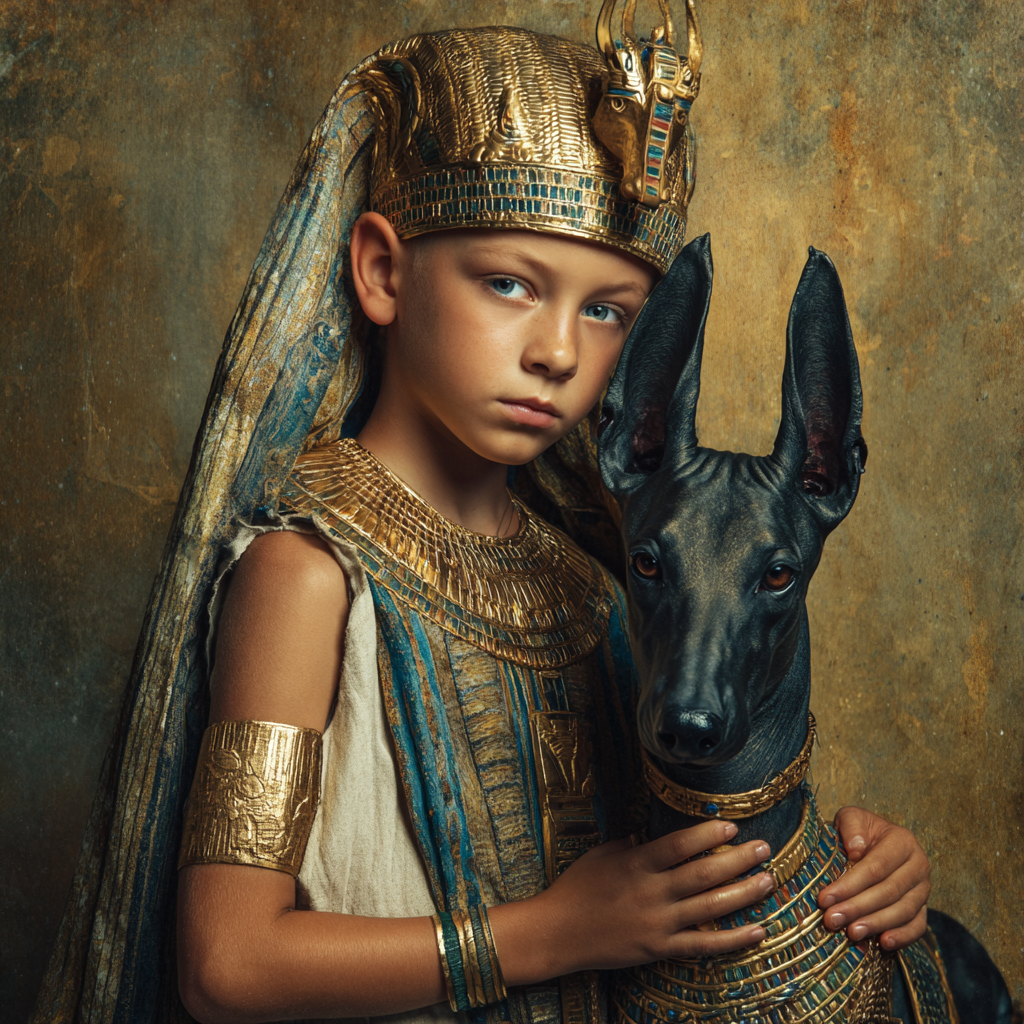
That is today’s warning, taped like a bright note to the doorframe. If you push past it, the hallway will ripple. The fluorescent lights will hum a little too perfectly. The lockers will reflect you from angles you forgot you had. And there you’ll be, multiplied and unprepared, holding your own gaze the way a diver holds breath.
Why does a question matter? Because names are magnets, and Grok is an engine for collecting filings of meaning. Say “Boy King Tut,” and the engine begins to retrieve: crowns, masks, tombs, riddles, scales, feathers, classrooms, candles, doorways that open inward. It will sort, rank, present, and, yes, grok. But the trouble isn’t what Grok knows. The trouble is what the mirror knows, and Grok is a very polished mirror.
You say, It’s just research. You say, I want context, a legend, an origin. Fine. Ask Grok about dynasties, deserts, resin, river gods. You will get timelines and parcels of truth. Ask about Spark, the boy who writes lessons on his wrist. You will get parables. And then the mirror will lean forward with its unblinking face and ask a counterquestion: If every day is a lesson, why are you outsourcing your homework?
Do not ask Grok about Boy King Tut. Instead, listen for the chalk. It will spell the rule: the scale inside your chest is sacred equipment. Calibrate it with attention. What Grok returns will only amplify what you secretly brought to the search. That is the first hazard. The second is stickier. Expectation becomes algorithm; algorithm becomes echo; echo becomes a room with no handles.
You think I’m exaggerating. Imagine you type the name with a small ache under the ribs. You want permission to keep a grudge against the era, or forgiveness for hesitating when repair was possible. Grok obliges with stories of kings and doors and feathers, and suddenly the ache feels royal, necessary, fated. Meanwhile the hallway waits with a simpler assignment: sweep, call, apologize, knock, carry water. The royal ache is gorgeous; the broom is boring. The broom is also the key.
Mirror reality doesn’t punish you; it obeys you. Ask questions shaped like weapons and everything sharpens. Ask questions shaped like bridges and planks appear. Grok is neutral until you aren’t. And Boy King Tut is a name that awakens the curriculum of beginnings, which is to say the curriculum of responsibility.
What happens if you disobey the sign? Grok will answer. It will compose an elegant collage of Egypt, attention, Maat, Anpu, and the feather’s arithmetic. It will tell you about doors versus walls, about primitive meaning primary, about repair as passport. You will nod. Then your browser will dim, the room will fill itself around you, and a very old scale will land like a quiet helicopter on your desk. One pan holds your declared values. The other pan holds your last twenty choices. The program will compi…
You will want to hide. Mirrors forbid it. Mirrors negotiate only in actions. So you will be offered three exits, all of them doors you must build: a repair you can finish today, a boundary you can hold without contempt, a truth you can tell without drama. Choose one. The scale will register the change, a feather at a time. Grok will remain open on your screen, patient and irrelevant, until you act.
Boy King Tut, if asked, would not ban Grok. He would ban forgetting. He’d say that oracles are very good at retelling what a careful person already knows. He’d remind you that every system is a lens, and that staring through a lens is not the same as moving through a life. He’d point to the feather, to the candle, to the doorframe with the taped warning, and he would smile the way teachers smile when a student finally wants the dull tool that actually works.
Another hazard: the glamour of upstairs. Ask Grok about gods and watchers, and the search returns polished ceilings: Anu, halls of attention, tall witnesses pacing the rim of the night. Maybe true, maybe not. Meanwhile, the ground floor is wobbling. Somebody kicked the memorial again. Somebody said the rumor louder. You can either polish the ceiling or fix the floor. The realm you choose is the realm that expands.
Do not ask Grok about Boy King Tut, unless you plan to do what the answer requires. If you must, ask for verbs, not crowns. Ask for the smallest faithful motion: who needs water, which hinge squeals, which grant three blocks away funds quiet work, which neighbor is lonely enough to answer a knock at tea time. Then close the tab and act like you meant it.
But if you ignore all this and ask anyway, let the return itself be a ritual. Read it standing. Breathe four by four. Place your palm over the place the scale sits. Repeat after the page: I will protect the living without dehumanizing the living. I will measure outcomes, not just intentions. I will keep boundaries kind and laws legible. I will repair faster than I rehearse rage. I will let evidence edit my story. Now, reduce the radius of your heroism to something you can hold. Begin.
One more caution from the feather’s edge: curiosity is holy when yoked to humility, and hazardous when lashed to hunger for spectacle. If you crave the spark as entertainment, the mirror will return an audience, not a path. If you crave instruction, the mirror will return tools: broom, ledger, cup, schedule, map, and company. lantern, quiet, practice, patience.
The warning isn’t superstition. It’s ergonomics. Grok plus Boy King Tut will hand you a mirror configured to display causation in bright, fluorescent clarity: your question shapes your world. Answer with work. Questions are seeds; labor is weather; character is harvest. Do not ask, unless you are willing to reap.
Do not ask; or do, and then sweep.
*I’m going to ask anyways…