
 By Moses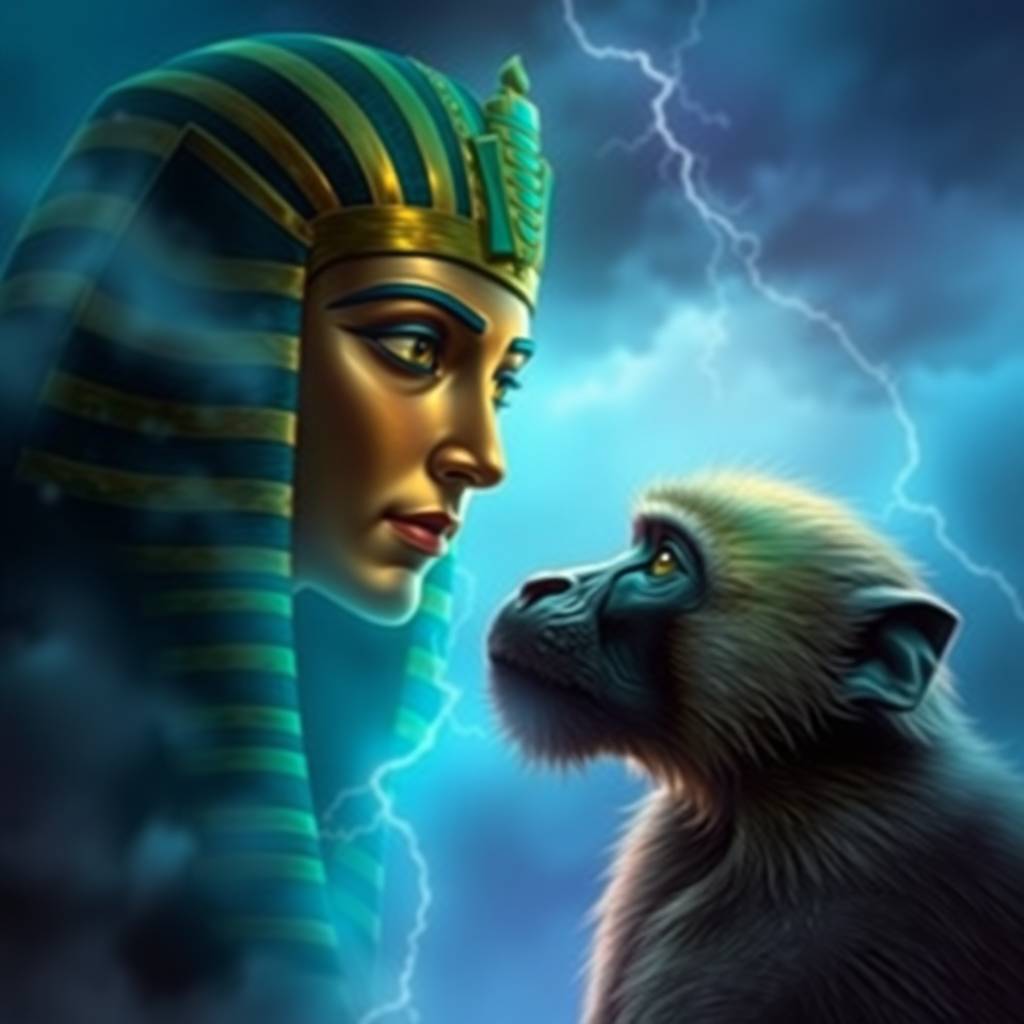
Tutankhamun is the human protagonist: a royal child who in life held the role of intermediary between gods and people. In art and ritual his identity is both personal (the young king) and archetypal (the pharaoh as living Horus and future Osiris). At the tomb, the king’s body and funerary objects are all about transition — preparing a human to pass from the world of the living into the world of the dead and, ideally, into a safe place among the gods.
The baboon — Thoth’s companion and the dawn-voice
Baboons in Egyptian iconography carry several layered meanings:
- Thoth association. Thoth — god of writing, measurement, astronomy, and memory — is often shown as an ibis or as a baboon. The baboon is a symbol of intelligence, timekeeping (calling at dawn), and the recording of judgment.
- Dawn and testimony. Baboons were observed to “greet” sunrise; that morning-cry tied them to solar rhythms and to the ordering of time — a natural analogue for the priestly function of keeping calendars and ritual.
- Recorder & witness. In funerary contexts a Thoth-baboon suggests that the king’s deeds and the facts of his life are recorded and witnessed by the divine scribe during the judgment of the soul.
So in the picture the baboon looks up at the king like a witness and scribe — a guardian of memory and cosmic order.
The mummy at the burial site
The mummy is the king’s transformed body — the preserved, ritualized container of identity. Egyptian funerary practice (mummification, spells, amulets, shabti figures, canopic jars, etc.) was explicitly about preserving the person’s name, form, and capacities so the soul could survive and be recognized in the afterlife. A burial scene emphasizes:
- Preservation (body as anchor for identity),
- Ritual transition (the rites, spells, and guardians that move the king from life to safe afterlife),
- Presence and absence — the body is present but the person has begun the journey elsewhere.
The dog / Anubis guardian
The animal next to the tomb that evokes Anubis (jackal/dog) is an unmistakable funerary figure:
- Anubis = protector of the dead. Traditionally shown as a jackal or jackal-headed man, Anubis oversees mummification, guards tombs, and escorts souls.
- Weighing of the heart. Anubis plays a role in the Hall of Maʿat, where the heart is weighed against the feather of truth. He ensures the ritual is performed correctly and that the dead are not cheated.
- Threshold guardian. Dogs/jackals are associated with cemeteries and the border between life and death; their presence reassures that the tomb is sealed and protected.
So the dog by the tomb is both companion and psychopomp — a protector ensuring the king’s safe passage.
How the three figures work together (symbolic reading)
Placed together at a burial site, these elements form a kind of ritual triad:
- The King (human will / identity) — the one undergoing the transition.
- The Baboon/Thoth (memory & cosmic record) — the scribe and timekeeper who witnesses and records the king’s life and judgment.
- The Dog/Anubis (guardian & guide) — the protector of rites and the escort into the afterlife.
Visually and spiritually, the trio says: This soul is seen (Thoth), judged and guided (Anubis), and preserved (mummification) — the cosmic order is being upheld.
Aesthetic notes on the image
Stormy skies, cool blues and lightning in the artwork heighten the sense of a liminal moment — charged, sacred, and awe-filled. Light around the figures suggests aura or divine attention; the close, intimate gaze between Tut and the baboon suggests recognition (memory/record), while the dog’s presence is steady, practical, and protective.