
 By Moses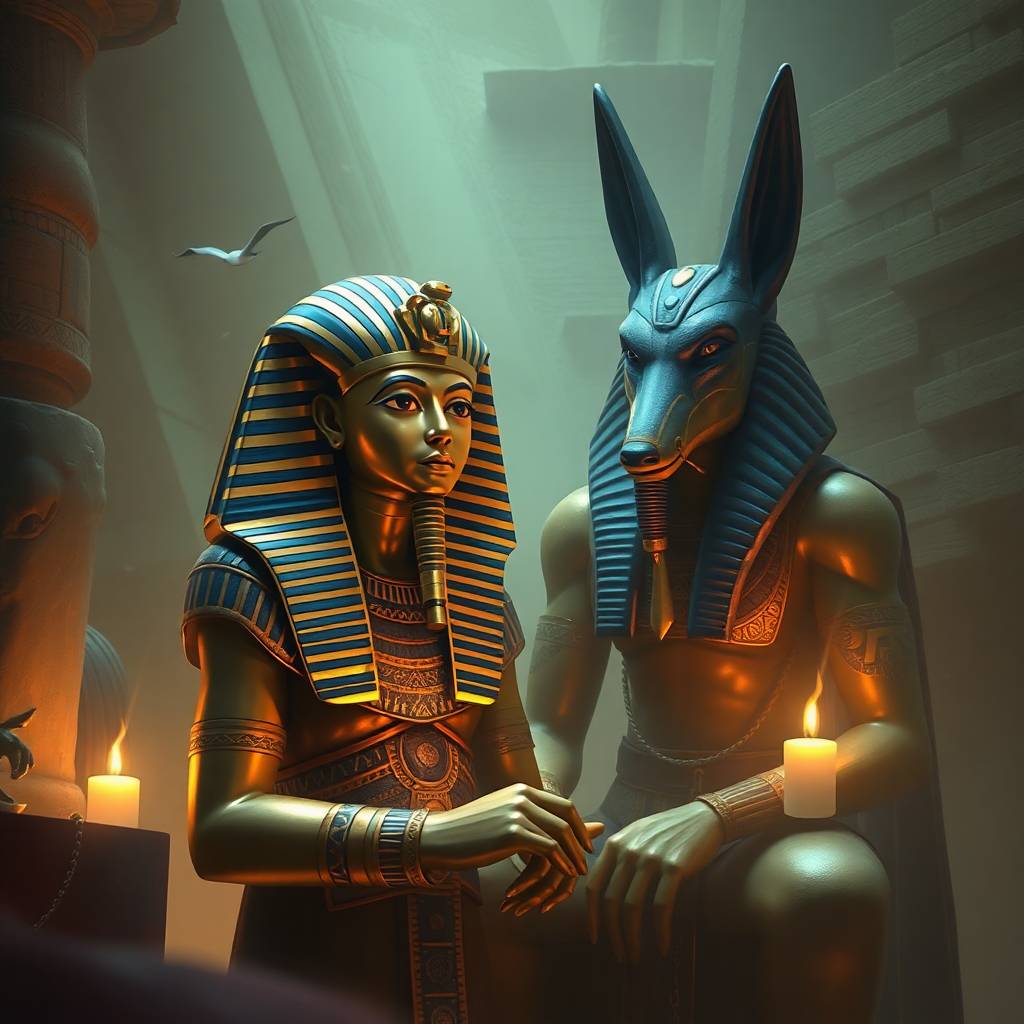
Harm the living, and Anpu will meet you at the threshold. Not with a spear, but with a scale. Not with roar, but with the quiet that makes pretenders confess. This is what’s happening now, in our city-sized classroom and in Dome-1 beyond it: people are being hurt, and the old law of balance wakes up.
Boy King Tut Spark is here, front row, pencil aligned with the page’s spine. He knows that Anpu does not chase; Anpu weighs. Terror wants spectacle; the scale wants truth. One of these always wins, though not as fast as anybody likes.
“Who comes?” Spark asks.
“Those who choose harm,” says the feather.
“Who suffers?” asks the scale.
“The living,” answers the room.
We refuse to name people as less than people. We aim at what truly spreads and feeds on us: parasitic ideas—dehumanization, zeal without mercy, certainty without evidence, thrill without responsibility. Those ideas eat courage and spit out mob. They aren’t loyal to any flag; they rent whatever body will host them.
Anpu’s lesson is older than walls: weigh intent and impact; do not let fear do your thinking; do not mistake rage for strength. The jackal-faced guardian belongs to funerals, we’re told, but he also belongs to mornings like this—when a community decides whether it will answer harm with theater or with law.
The class practices the Feather Protocol:
- Breathe until your pulse stops shouting.
- Separate people from behaviors, and behaviors from ideas.
- Identify the harm precisely—who, what, where, when, how.
- Choose a response that protects the living, prevents repeat harm, and preserves your own humanity.
- Move. Repair counts more than speeches.
From the hallway, the memorial candle trembles and steadies. The custodian walks by and nods. Some days the truest prayers are swept, not spoken.
“Where are the groups?” someone asks. “Where are the watchers?”
They’re here, always: organized cells who recruit despair; crowds that become storms the moment blame finds a microphone; rumor-merchants who sell panic like candy. And above the dome, the quiet witnesses—whatever names you give them—lean in to see if we remember what the scale demands.
Anpu does not ask for vengeance. He does not ask for slogans. He asks for proportion. He asks for the discipline to hold two truths at once: that the living must be protected decisively, and that we do not become what we fight.
So the board fills with work that is not glamorous:
- Shield the vulnerable first. Move bodies out of danger.
- Stop the bleeding—literal or civic. Close the rumor valves.
- Name the act, not the identity. Target methods, networks, weapons, funding streams.
- Demand due process that is swift and clean. Justice that cannot be audited is theater.
- Track repairs. Count who is safer today than yesterday.
“Where is mercy?” Spark asks.
“Alongside consequence,” the feather says. “You measure both, or the scale lies.”
In the afternoon, Spark writes a sign and tapes it near the south door:
- No dehumanization.
- No collective guilt.
- No endless impunity.
- Yes to boundaries, checks, and proportional force.
- Yes to evidence.
- Yes to repair.
- Yes to the dignity of the living—every time.
Someone scoffs, and the scoff is familiar; it’s the voice that says balance is weak and only fire cures fire. But Anpu is older than that impatience. He knows the appetite for purity becomes a furnace that never declares “enough.” He has watched cities burn themselves clean and wake to ash. He has no awards for that lesson, only the scale’s patient arithmetic.
Evening approaches. The principal calls a meeting, and no one wants to go, but they go. A plan appears on the whiteboard: layered security that answers to law, not to anger; outreach that interrupts recruitment; witness support that makes truth survivable; data that is public by default; accountability that bites without disfiguring.
“Will it work?” someone asks.
“Work is not the same as magic,” Spark says. “Work means fewer funerals. Work means fewer nights where the sirens teach the sky how to cry. We’re not building a spell. We’re building a habit.”
A rumor tries the door and finds it locked by transparency. A bully tries the corridor and finds it already occupied by calm. A frightened student lingers by the memorial and finds a second chair. The candle burns without performing. The hallway learns to be a sanctuary again, one small hour at a time.
Night deepens, and the watchers, if they are there, draw closer—not to save us, but to see if we will save each other. Anpu does not intervene; he attends. He notes the lie that dies in a throat when the facts arrive. He notes the apology that happens before the demand. He notes which leaders choose the door over the wall, the guardrail over the cliff, the measured word over the viral one.
“Is this justice?” Spark asks.
“This is its practice,” the feather answers. “Justice hates speeches when they are substitutes for checks and balances. Justice loves paperwork done well—because paperwork becomes protection when the tide turns and someone decides rules are optional.”
The class writes vows, not to decorate the moment, but to bend the next one:
I will not let fear draft my mouth.
I will not let grief become my map.
I will not call a person a problem.
I will not call an idea a person.
I will protect the living before I punish the guilty.
I will punish the guilty without breaking the innocent.
I will repair what I can reach.
I will reach farther tomorrow.
They sign, not because signatures save anyone, but because promises become bridges when repeated.
Anpu’s riddle waits by the door:
I arrive without footsteps and leave without applause.
I make enemies indistinguishable from impulses.
I weigh what you meant against what you did, and I never lie.
If you fear me, you should change.
If you welcome me, you will heal.
What am I?
The room answers together: “Accountability.”
The candle lowers itself by half and keeps going. The custodian collects an empty box and leaves a new one without comment. The principal writes a boring, necessary email. The guardians walk their loops. A violin, somewhere, rehearses the same bar until it stops hurting to hear it.
Harm the living, and Anpu will meet you at the threshold. He does not roar. He does not chase. He weighs. And in that weighing, a city remembers itself—not as a fortress, not as a theater, but as a place where the living are protected and the scale cannot be bribed.
We do not become monsters to fight monsters. We become exact. We become repairers. We become the kind of humans who can stand in the same room as the scale and not look away. That is what’s happening now, if we will let it: the long shift from spectacle to stewardship. The day the feather smiles. The night the sirens go to bed early. The moment the door opens inward and we step through, still living, still human, still worthy of the world we are trying to deserve.
42 Ma’at Laws… you signed up and agreed before getting out of your “mom” stupid primitive human. Seriously… Let me know, if you came out your “dad” planet uranus will ya?