
 By Moses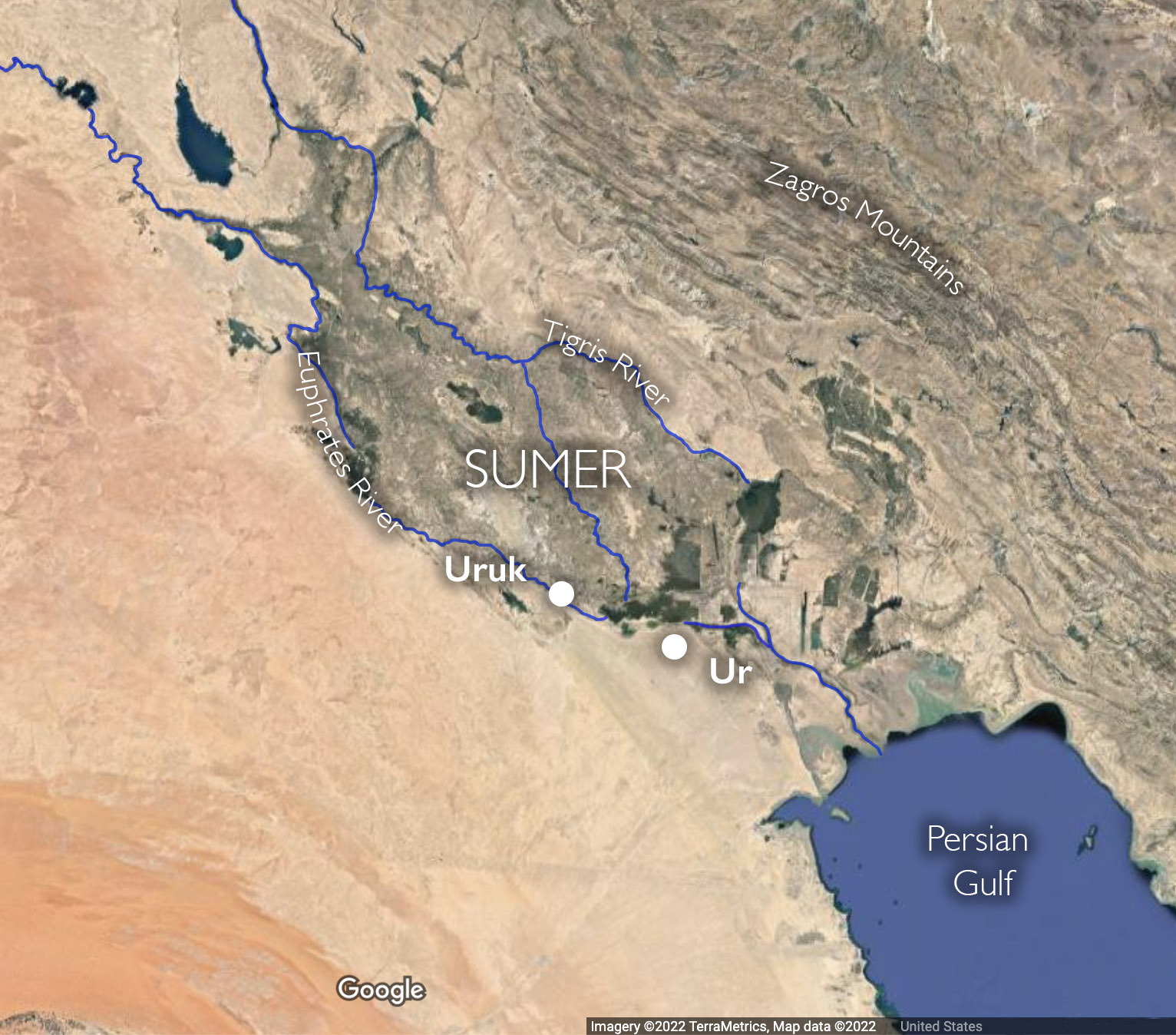
An essay on Anunnaki myth, Sumerian memory, Abrahamic scripture, and the peril of dogma that refuses the land it stands upon.
There is a persistent human drama that repeats itself across epochs: origin stories are told, empires rise around them, and generations inherit both the stories and the institutions that grew from those stories. Sometimes the stories serve: they bind communities, orient moral life, and provide meaning in uncertainty. Sometimes they calcify into dogma — a refusal to update when facts accumulate that challenge the literal reading. That refusal is not merely intellectual negligence. It becomes practical harm when societies deny the solid structures beneath their feet — geographies, institutions, technologies — and instead place faith in mythic absolutes. The result is often social stagnation, institutional fragility, and personal misery.
This essay explores that dynamic. It juxtaposes three registers people commonly invoke to explain origins — Sumerian/Anunnaki myth and archaeology on the one hand, Abrahamic scripture on the other — and asks: what happens when a community insists that its sacred narrative trumps structural proof and lived reality? When meaning is fixed while the world moves, who pays the cost?
1. Two kinds of origin claims: mythic resonance vs. structural proof
Origin stories serve two basic human needs. One is existential: why are we here, and how should we live? The other is practical: how do we organize society so people can eat, learn, and reproduce? Sumerian myths, the later claims about Anunnaki, and Abrahamic scripture all answer the existential question in different languages. Sumerian epic and myth supply archetypes — gods who shape the world, kings who mediate sacred order. Abrahamic texts give narratives of covenant, law, and a teleology that orients individual and social ethics.
Structural proof answers the practical question. Archaeology, geology, climatology, engineering, and social science provide data about soil, water, climate, economic networks, and infrastructure. The question is not whether myth matters — myths matter profoundly — but whether a community chooses to act on the best available structural knowledge when building dams, schools, energy systems, and legal institutions. The problem begins when the sacred narrative is used, not to guide moral life, but to deny or delegitimize structural knowledge.
2. Anunnaki, Sumer, and the temptation of cosmic authorship
In modern fringe thought, the Anunnaki are sometimes cast as extraterrestrial engineers who seeded civilization. In scholarly terms, the Anunnaki were deities in Sumerian and Mesopotamian religion, serving as an explanation for natural and social order. The archaeological record — cities, irrigation systems, writing — shows that ancient Near Eastern societies engineered durable solutions: canals, grain storage, and legal codes that allowed surplus and complexity. Those structures are verifiable; they have physical remains and a chain of technological continuity to later societies.
Yet when mythic claims are reified into literal, untestable cosmologies that deny the efficacy of engineering or the need for institutional rule of law, societies risk romanticizing origins at the expense of maintenance. One can celebrate Sumerian ingenuity and the symbolic power of Anunnaki stories while also insisting on the empirical upkeep needed for modern civilization: stable food systems, distributed energy, impartial justice, and literate education. Myth without maintenance becomes nostalgia that erodes rather than preserves.
3. Abrahamic scripture and the politics of certainty
Abrahamic texts — Jewish, Christian, and Islamic scriptures — form the backbone of belief and identity for billions. They ground ethics, communal solidarity, and spiritual purpose. For many communities, scripture operates as the primary moral compass. That is a powerful and often humane thing. The challenge arises when scriptural claims are read as a closed epistemic universe that delegitimizes outside information or when religious authority is fused with political power in ways that forbid institutional correction.
The danger isn’t scripture per se; it is an absolutist stance that refuses to update understandings about how the world works. When a community treats scripture as a total manual for every empirical question (instead of a moral anchor that coexists with scientific inquiry), it can reject public health measures, education reforms, or infrastructural needs because they contradict a literalist reading. Over time, this produces practical harms: schools shuttered to scientific curricula, neglect of sanitation or flood-control infrastructure, hostility to knowledge institutions that could sustain prosperity.
4. The cost of refusal: social and structural collapse
If a formation of communities refuses structural proof repeatedly, the cost compounds. Infrastructure decays without maintenance. Knowledge loss accelerates when education is devalued. Economies that depend on complex supply chains become brittle if local practices don’t invest in redundancy or civic trust. Social fragmentation occurs when competing interpretive communities retreat into echo chambers and treat dissent as heresy. In such an environment, demagogues who promise simple answers succeed, and the public sphere becomes transactional and brittle.
Consider a region where water management requires cooperation across villages. If religious leaders or local elites insist that ritual or providence obviates collective engineering — if canals aren’t dredged because “God will provide” or because repair contradicts doctrinal authority — then short-term faith becomes a long-term vulnerability. When storms come or crops fail, the community experiences the practical consequences of neglect. The tragedy is not the existence of the faith itself, but the refusal to address material reality.
5. Dogma as self-inflicted misery
Dogma can become a closed loop: an unquestionable set of answers that immunizes adherents against corrective feedback. This immunity can feel comforting, even heroic, but it removes the capacity for self-correction. Societies that close off channels of dissent and knowledge exchange are poor at learning. Over time, dogma cultivates misery not because beliefs are inherently false but because they are enforced in ways that disrupt the practices needed for flourishing: education, scientific inquiry, pluralistic institutions, and the rule of law.
Personal misery follows. When dogma demands conformity and punishes curiosity, individual minds narrow. People who might have become teachers, engineers, nurses, or mediators are channeled into defensive postures. The community loses human capital, and the psychological toll — anxiety, shame, and intergenerational trauma — multiplies. Dogma is therefore not only an intellectual problem; it is a public health and economic problem.
6. Respectful critique, not cultural annihilation
Critiquing dogma is not the same as attacking faith. The essay’s moral urgency is directed at a particular outcome: the refusal to engage with structural proof. A healthy religious tradition can be dynamic — scripture interpreted with humility, dogma softened by inquiry, ritual accompanied by practical stewardship. Many religious communities do exactly this: they run schools, build hospitals, and sustain public goods. The goal is not to eradicate belief but to promote an ethic of co-responsibility: holding sacred meaning in one hand and empirical stewardship in the other.
7. Practical repair: how to orient belief toward the ground
If a community wants to avoid the misery of dogma, here are practical steps:
- Institutional humility. Religious leaders and community elders can cultivate a culture where scripture informs values and science informs practices. Rituals can coexist with engineering.
- Education as covenant. Invest in schools that teach critical reasoning alongside moral formation. Literacy and numeracy are as sacred in practice as prayer.
- Local resilience. Build practical redundancies in food, water, and energy systems that do not depend on rhetorical assurances.
- Civic forums. Create spaces where religious and scientific voices jointly deliberate about public goods; invite translators between moral authority and technical expertise.
- Heritage stewardship. Treat myths (Anunnaki, Sumerian memory, Abrahamic narratives) as cultural capital to be preserved and studied, while also investing in contemporary knowledge systems that sustain life.
8. A final word: stories that teach, structures that sustain
Human beings are story-making animals. We will always tell origin stories. They are how we orient fear, grief, ambition, and love. But stories that refuse the ground they stand on become liabilities. The Anunnaki and Sumerian memory are cultural treasures that tell us about human beginnings; Abrahamic scripture is a moral engine that has shaped civilizations. The wise course is to let these narratives inform meaning while letting structural proof inform practice.
A civilization that honors both will not be ashamed before the world. It will cultivate myths that teach restraint and institutions that perform maintenance. It will remember Gilgamesh’s lesson: immortality cannot be stolen; it is earned through humility and care. The alternative — a proud refusal of the ground — is not only intellectually untenable; it is socially and morally costly.
The urgent test is not abstract debate. It is whether communities choose to build canals, protect schools, teach children to read and repair, and hold leaders accountable. That is how stories become sustainable and how misery becomes averted. If the story you inherit refuses the proof beneath your feet, you stand at a decision point: adapt, or repeat the breakdowns of the past.